The AI Agent Governance Layer Most Small Teams Skip
Revised 7 min read
By Jake Bauman
ai-agents / governance / production / build-notes
Gartner's May 2026 statement argues that applying the same governance regardless of an agent's autonomy and access can lead to failure. Its point is about proportional controls, not that governance itself causes failure. My checklist below adapts that principle for small teams.
These are operating patterns and illustrative examples, not results from a published test of my own agents. The right controls depend on the data, permissions, and potential harm of each workflow.
Why uniform governance fails
The instinct is reasonable. You build one set of rules and apply them to every agent. Every output gets checked against the same criteria. Every failure gets logged to the same dashboard.
The problem is that different agents fail in different ways. A content generation agent fails by producing copy that sounds right but contains a factual error. A customer segmentation agent fails by putting high-value customers into a low-priority bucket. A scheduling agent fails by double-booking. The same governance checks cannot catch all three.
Gartner describes a binary approach in which agents are either locked down or fully trusted. That can over-restrict a low-risk task or under-protect a more autonomous one. Match permissions and review to the actual trust boundary.
The alternative is not more governance. It is governance that matches the failure mode.
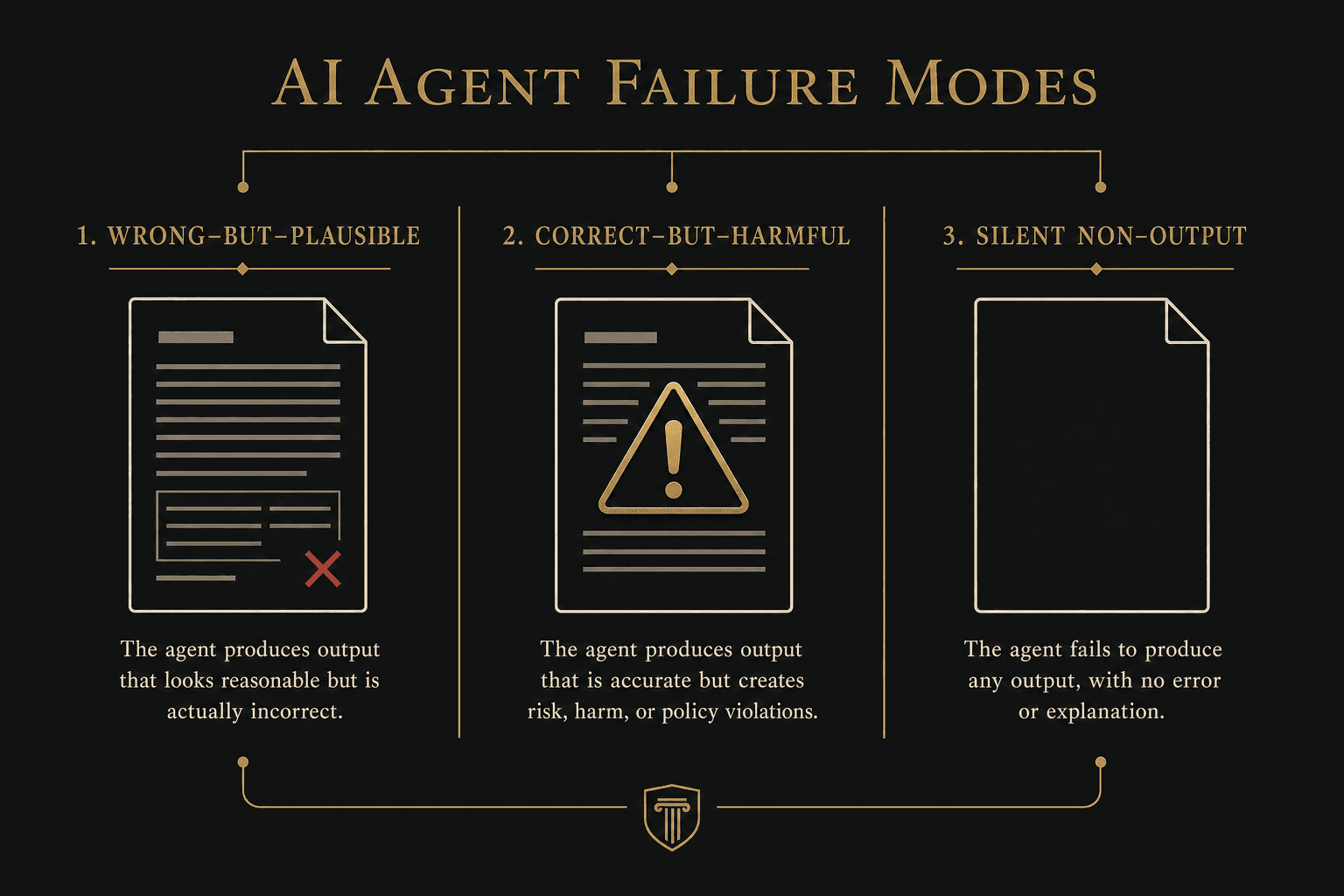
The three failure modes that actually matter
I use three categories to make review concrete. They do not cover every possible failure.
Mode 1: Wrong-but-plausible output
This is the silent killer. The agent produces output that looks correct but is factually wrong. A blog post draft that cites a study that does not exist. A customer email that references a discount the customer does not qualify for. A lead score that overweights a signal that stopped being predictive six months ago.
Wrong-but-plausible output is dangerous because it clears the basic checks. The grammar is fine. The formatting is correct. The system logs show a successful run. The only way to catch it is to validate against ground truth.
Mode 2: Correct-but-harmful output
This one is harder to spot. The output is factually correct but contextually wrong. An agent correctly identifies a customer as high-intent based on their browsing behavior and sends an aggressive discount. The browsing behavior was the customer's teenager using their phone. The discount goes to the wrong person. The output was correct. The signal was misleading.
Correct-but-harmful failures usually involve timing, audience, or channel. The agent did what it was told. The instruction was incomplete.
Mode 3: Silent non-output
The agent runs successfully and produces nothing wrong because it produces nothing at all. A pipeline step times out. An API call fails silently. A rate limit kicks in and the agent retries three times, then skips the task without logging the skip.
Silent non-output is the hardest to detect because monitoring dashboards track errors, not absences. If you do not explicitly measure whether the agent did the thing it was supposed to do, you will not know it did not do it.
Three lightweight validation patterns
Each failure mode needs a different check. None of these require enterprise tooling. Start with the check that addresses the most consequential error in your workflow.
Pattern 1: Ground truth spot checks (for wrong-but-plausible)
Pick one factual claim per agent run and validate it. Not every claim. One. If the agent cites a number, check the number. If it references a research finding, verify the finding exists. If it segments a customer, pull that customer's actual purchase history and confirm the segment makes sense.
This takes about 30 seconds per run if you automate the extraction. Write a simple script that pulls the first factual claim from the agent's output and runs it against your database or a quick search. If the claim does not check out, flag the entire run for review. One correct claim does not validate the rest of the output.
The spot check does not need to be perfect. It needs to be consistent. For customer-facing or high-impact work, verify every material factual claim before release. A spot check is a monitoring sample, not a release gate.
Pattern 2: Boundary rules (for correct-but-harmful)
Write five rules that define what the agent should never do, regardless of what the data says. These are not guidelines. They are hard stops.
Illustrative boundary rules: never send more than one email to the same customer in a 24-hour window. Never apply a discount above 30 percent without human approval. Never include a customer's personal information in a subject line. Never send to a list segment smaller than 50 people. Never publish a blog post without a human reading the first paragraph.
Boundary rules take 20 minutes to write and another 20 minutes to implement as pre-send checks. They can stop specific, known harms. Test each rule and inspect what it misses.
Pattern 3: Completion assertions (for silent non-output)
After every agent run, assert that the expected outputs exist. Did the agent create a draft? Check that the file exists and is not empty. Did it update a CRM record? Query the record and confirm the timestamp changed. Did it send an email? Check the send log.
Completion assertions are boring. They are also the most reliable governance check I have found. They can detect missing expected outputs when the assertion and the underlying data source are reliable. They do not validate output quality.
Worked review: a plausible claim with no evidence
This is a synthetic editorial exercise, using Beacon Payroll, the invented company in the Starter Kit's offer-page review. It shows a human decision about draft copy, not a live customer result or a recorded Quality Gate run.
| Review step | What the supplied example says | Decision | | --- | --- | --- | | Input | The page serves finance and operations leads at companies with 20 to 200 employees. Its headline promises a faster pay run. The supplied proof shows an approval screen, a customer-count claim, and setup-time copy, but no measured pay-run duration. | The audience is clear; the speed claim still needs evidence. | | Unsafe draft | “A 120-person pay run takes 11 minutes.” This is the form of a stronger proof point in the example, conditional on a real measurement. No such measurement was supplied. | Fail the factual check. Do not publish the number or let a reviewer invent it. | | Interim revision | “Payroll software for teams of 20 to 200 employees.” The primary action stays “Book a 20-minute walkthrough.” Both details come from the supplied input. | This is narrower copy the editor can use while the speed claim is investigated. It is a proposed rewrite, not a tested conversion winner. | | Remaining checks | The example also lists five competing actions and an unanswered migration question. | Reduce action conflict and ask the business to document migration. Do not write an answer on its behalf. |
The release record would show the original page, the unsupported claim, the editor's proposed revision, the person who approved it, and the evidence still needed. If the company later measures pay-run time, record the method and population before restoring a numerical promise. A clean sentence is not a pass when its key fact is missing.
Where human review actually belongs
Human approval may be appropriate for every output in a high-impact or low-volume workflow. Set the gate according to risk and capacity.
Human review should sit at exactly one point in the pipeline: the boundary. Before an agent takes an action that costs money, changes a customer relationship, or publishes something public, a human should see it. Earlier steps also need appropriate access controls and monitoring.
This is the governance sweet spot. Automate the checks. Reserve the human for the moment of commitment.
What to measure
Track failed checks, missed outputs, factual corrections, and escalations. Review a sample of passing runs too, because a checker can miss an error.
Most teams measure agent uptime and error count. Those numbers are useful for infrastructure but useless for governance. An agent that runs successfully 100 percent of the time while producing wrong-but-plausible output is not a success. It is a liability with good uptime.
The one rule that matters
Governance is not about trust. It is about verification. You do not need to trust your agents. You need to verify that they did what you asked.
Gartner recommends controls proportionate to autonomy and trust boundaries. Match each check to a failure mode, keep records, and revise controls after an incident.
For a structured review of generated outputs, see the Quality Gate.